
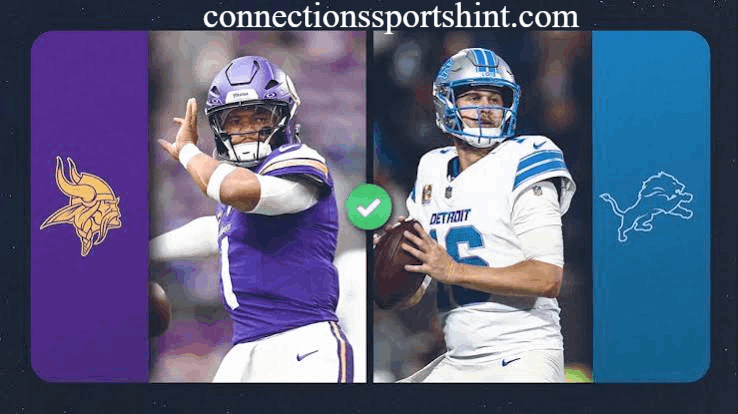
The Detroit Lions delivered an impressive performance against the Minnesota Vikings, securing a 19–15 victory at Ford Field on November 1, 2026. The closely contested NFC North matchup ended Minnesota’s unbeaten start to the season, giving the Vikings their first defeat after winning six consecutive games. Detroit improved its record to 5–2 with an important divisional victory.
The Detroit Lions vs Minnesota Vikings match player stats reveal how Detroit’s powerful rushing attack and late-game execution made the difference. Jahmyr Gibbs led the Lions with 153 rushing yards and a touchdown, while quarterback Kyler Murray recorded 210 passing yards and two touchdowns for Minnesota. Despite Murray’s productive performance, Detroit controlled possession and produced more total offensive yards to secure the win.
Detroit Lions vs Minnesota Vikings Match Overview
The November 1 matchup at Ford Field featured two competitive NFC North teams with strong ambitions for the 2026 NFL season. Minnesota entered the contest with a 6–0 record, hoping to extend its winning streak, while Detroit looked to strengthen its position in the division. The Lions started steadily, scoring three points in the opening quarter and adding another field goal before halftime.
Minnesota briefly took control through its passing offense, but Detroit responded with an important third-quarter rushing touchdown from Jahmyr Gibbs. The Vikings scored eight points in the fourth quarter to move ahead 15–12. However, Jared Goff connected with Jameson Williams for a late touchdown, giving Detroit a 19–15 advantage that Minnesota could not overcome.
| Match Detail | Result |
|---|---|
| Matchup | Detroit Lions vs Minnesota Vikings |
| Date | November 1, 2026 |
| Stadium | Ford Field |
| Final Score | Lions 19–15 Vikings |
| Lions Record | 5–2 |
| Vikings Record | 6–1 |
| Winning Team | Detroit Lions |
| Losing Team | Minnesota Vikings |
Detroit Lions vs Minnesota Vikings Match Player Stats
The individual performances tell an interesting story about this matchup. Minnesota produced more passing yards through Kyler Murray, but Detroit found greater success running the football. The Lions’ balanced offensive approach helped them maintain possession, create scoring opportunities, and control important moments throughout the game.
Here is a breakdown of the leading offensive players from both teams, including passing, rushing, and receiving contributions.
| Player | Team | Passing Yards | Rushing Yards | Receiving Yards |
|---|---|---|---|---|
| Kyler Murray | Vikings | 210 | 35 | — |
| Jared Goff | Lions | 176 | 0 | — |
| Jahmyr Gibbs | Lions | — | 153 | 15 |
| Sione Vaki | Lions | — | 65 | 5 |
| Aaron Jones | Vikings | — | 22 | 18 |
| Jordan Mason | Vikings | — | 20 | — |
Gibbs was Detroit’s biggest offensive contributor, combining 153 rushing yards with 15 receiving yards. Sione Vaki also provided valuable support with 65 rushing yards. For Minnesota, Murray contributed through both passing and rushing, while the Vikings’ running backs struggled to produce the same level of ground offense as Detroit. These differences played an important role in determining the final result.
Detroit Lions Player Stats and Top Performers
The Detroit Lions relied heavily on their running game, and Jahmyr Gibbs delivered one of the strongest individual performances of the matchup. He recorded 23 carries for 153 yards and scored one rushing touchdown. His 30-yard touchdown run in the third quarter demonstrated his acceleration and ability to break tackles. Gibbs consistently created opportunities for Detroit and helped the offense maintain pressure on Minnesota’s defense.
Jared Goff also played an important role despite finishing with fewer passing yards than Murray. He completed 18 of 25 attempts for 176 yards, one touchdown, and one interception. His late fourth-quarter connection with Jameson Williams produced the winning touchdown. Other contributors included Sione Vaki, who added 65 rushing yards, and Amon-Ra St. Brown, who finished with seven receptions for 46 yards.
Detroit’s leading offensive performers included:
- Jahmyr Gibbs: 153 rushing yards, one rushing touchdown, and 15 receiving yards.
- Jared Goff: 176 passing yards, one passing touchdown, and one interception.
- Jameson Williams: Four receptions, 70 receiving yards, and one touchdown.
- Amon-Ra St. Brown: Seven receptions for 46 yards.
- Sione Vaki: 65 rushing yards on 11 carries.
- Sam LaPorta: Three receptions for 33 yards.
Minnesota Vikings Player Stats and Top Performers
Minnesota’s offense showed flashes of quality, particularly through its passing game. Kyler Murray completed 17 of 29 passes for 210 yards, two touchdowns, and one interception. He also added 35 rushing yards on four attempts. Murray connected with Justin Jefferson and T.J. Hockenson for touchdowns, keeping Minnesota competitive throughout the contest. However, the Vikings could not consistently match Detroit’s ground production.
The receiving unit also provided several important contributions. Jordan Addison led Minnesota in receiving yards with 66 on three catches, while T.J. Hockenson recorded four receptions for 58 yards and a touchdown. Justin Jefferson added five catches for 33 yards and another receiving touchdown. Aaron Jones contributed 22 rushing yards and 18 receiving yards, but Minnesota’s overall rushing attack remained limited.
Minnesota’s leading offensive performers were:
- Kyler Murray: 210 passing yards, two touchdowns, and one interception.
- Justin Jefferson: Five receptions, 33 yards, and one touchdown.
- T.J. Hockenson: Four receptions, 58 yards, and one touchdown.
- Jordan Addison: Three receptions for 66 yards.
- Aaron Jones: 22 rushing yards and 18 receiving yards.
- Jordan Mason: 20 rushing yards on eight carries.
Quarterback Comparison: Lions vs Vikings
The quarterback battle featured two different offensive approaches. Kyler Murray finished with more passing yards and touchdowns, but Jared Goff completed a higher percentage of his attempts. Murray’s mobility gave Minnesota an additional offensive dimension, while Goff focused on distributing the football and helping Detroit sustain its drives.
| Quarterback Statistic | Kyler Murray | Jared Goff |
|---|---|---|
| Team | Vikings | Lions |
| Completions | 17 | 18 |
| Attempts | 29 | 25 |
| Completion Percentage | 58.6% | 72% |
| Passing Yards | 210 | 176 |
| Passing Touchdowns | 2 | 1 |
| Interceptions | 1 | 1 |
| Rushing Attempts | 4 | 3 |
| Rushing Yards | 35 | 0 |
Murray had the advantage in passing yards, touchdowns, and rushing production. However, Goff delivered a more efficient completion percentage and made an important late-game connection with Williams. Both quarterbacks threw one interception, making the difference between their performances relatively small. Ultimately, Detroit’s stronger rushing attack gave Goff more offensive support.
Rushing and Receiving Stats Comparison
The rushing statistics were among the most important aspects of the game. Detroit recorded 230 net rushing yards compared with Minnesota’s 81. Gibbs led the way with 153 yards, while Vaki added another 65. Their combined production gave the Lions a reliable offensive foundation and helped them control the clock during important possessions.
Minnesota’s leading rusher was Murray with 35 yards, followed by Aaron Jones with 22 and Jordan Mason with 20. The Vikings also produced several receiving contributions, but Detroit’s passing attack delivered the decisive touchdown through Williams. The following table highlights the leading receivers from both teams.
| Receiving Player | Team | Receptions | Yards | Touchdowns |
|---|---|---|---|---|
| Jameson Williams | Lions | 4 | 70 | 1 |
| Amon-Ra St. Brown | Lions | 7 | 46 | 0 |
| Sam LaPorta | Lions | 3 | 33 | 0 |
| Jordan Addison | Vikings | 3 | 66 | 0 |
| T.J. Hockenson | Vikings | 4 | 58 | 1 |
| Justin Jefferson | Vikings | 5 | 33 | 1 |
Williams delivered Detroit’s most productive receiving performance, finishing with 70 yards and a touchdown. Addison recorded Minnesota’s highest receiving yardage, while Jefferson and Hockenson each found the end zone. These numbers demonstrate that both teams had capable receiving threats, even though Detroit ultimately produced the winning scoring play.
Defensive Player Stats and Key Contributions
Defense played an important role in this close divisional matchup. Although the offensive players attracted much of the attention, both defensive units created pressure and forced important mistakes. Each team recorded one interception, while Detroit’s defense helped limit Minnesota to 81 rushing yards. The Lions also benefited from controlling possession, which reduced the Vikings’ opportunities to build consistent offensive momentum.
Minnesota linebacker Andrew Van Ginkel recorded 2.5 sacks and four tackles, making him one of the Vikings’ notable defensive performers. Detroit also received contributions from its defensive front, including players who helped pressure Murray and disrupt Minnesota’s offensive rhythm. These defensive efforts were particularly important during the fourth quarter, when the Vikings attempted to protect their narrow lead.
Detroit Lions vs Minnesota Vikings Team Stats Comparison
The overall team numbers explain why Detroit won despite Minnesota having more passing yards and two passing touchdowns. The Lions accumulated 384 total yards compared with 266 for the Vikings. Detroit also produced 230 rushing yards, giving it a substantial advantage in offensive balance and possession time.
Another important difference was time of possession. Detroit controlled the football for 35 minutes and 43 seconds, while Minnesota held possession for 24 minutes and 17 seconds. The Lions also recorded 24 first downs compared with Minnesota’s 15. These advantages allowed Detroit to sustain drives and put additional pressure on the Vikings’ defense.
| Team Statistic | Vikings | Lions |
|---|---|---|
| Final Score | 15 | 19 |
| Total Yards | 266 | 384 |
| Passing Yards (Net) | 185 | 154 |
| Rushing Yards (Net) | 81 | 230 |
| Total Plays | 50 | 68 |
| First Downs | 15 | 24 |
| Time of Possession | 24:17 | 35:43 |
| Turnovers | 1 | 1 |
| Third-Down Efficiency | 3/10 | 5/13 |
| Penalties | 5 | 7 |
The biggest statistical advantage belonged to Detroit’s rushing offense and possession time. Minnesota actually gained more net passing yards, but the Lions’ ability to move the ball on the ground created a more balanced attack. Detroit’s 384 total yards and 24 first downs helped establish the foundation for its victory.
Key Moments That Decided the Game
Several moments shaped the outcome of this exciting NFC North contest. Detroit opened the scoring with a 25-yard field goal from Jake Bates. Minnesota responded with a touchdown pass from Murray to Jefferson, taking a 7–3 lead. Bates added another field goal before halftime, leaving the Vikings ahead 7–6 at the break.
Gibbs changed the momentum in the third quarter with a 30-yard rushing touchdown, giving Detroit a 12–7 advantage. Minnesota responded in the fourth quarter when Murray connected with Hockenson for an eight-yard touchdown. However, the Lions delivered the decisive play when Goff found Williams for a seven-yard touchdown with 4:35 remaining. Bates converted the extra point, securing Detroit’s 19–15 victory.
What the Result Means for the Minnesota Vikings and Detroit Lions
The victory improved Detroit’s record to 5–2 and provided an important boost in the NFC North race. Beating an undefeated opponent demonstrated the Lions’ ability to compete in high-pressure divisional games. Their running game was particularly encouraging, as Gibbs and Vaki combined for 218 rushing yards and helped the team maintain control throughout the matchup.
For Minnesota, the defeat ended its perfect start and moved its record to 6–1. Despite the loss, Murray’s passing performance and the contributions from Jefferson, Hockenson, and Addison showed that the offense still had significant potential. The Vikings will need to improve their rushing efficiency and find ways to maintain possession against strong defensive opponents as the season continues.
Conclusion
The Detroit Lions vs Minnesota Vikings match player stats highlight a competitive game decided by rushing production, offensive balance, and late-game execution. Detroit secured a 19–15 victory at Ford Field, with Jahmyr Gibbs leading the offense through 153 rushing yards and one touchdown. Jared Goff also delivered the decisive fourth-quarter touchdown pass to Jameson Williams.
Minnesota received productive performances from Kyler Murray, Justin Jefferson, T.J. Hockenson, and Jordan Addison, but its rushing offense could not match Detroit’s production. The Lions finished with 384 total yards and controlled possession for more than 35 minutes. The result ended Minnesota’s unbeaten start and gave Detroit an important divisional victory in the 2026 NFL season.

Frequently Asked Questions
Who won the Detroit Lions vs Minnesota Vikings game on November 1, 2026?
The Detroit Lions defeated the Minnesota Vikings 19–15 at Ford Field.
How many rushing yards did Jahmyr Gibbs record against the Vikings?
Jahmyr Gibbs recorded 153 rushing yards on 23 carries and scored one touchdown.
How did Kyler Murray perform against the Detroit Lions?
Kyler Murray completed 17 of 29 passes for 210 yards, two touchdowns, and one interception.
How many passing yards did Jared Goff record?
Jared Goff recorded 176 passing yards, one touchdown, and one interception.
Who had the most receiving yards in the Lions vs Vikings game?
Jameson Williams led all receivers with 70 yards on four receptions.
How many touchdowns did Justin Jefferson score against Detroit?
Justin Jefferson recorded one receiving touchdown along with five receptions for 33 yards.
What was the total yardage difference between the Lions and Vikings?
Detroit recorded 384 total yards, while Minnesota finished with 266, giving the Lions a 118-yard advantage.
Where did the Detroit Lions vs Minnesota Vikings game take place?
The game took place at Ford Field in Detroit, Michigan, on November 1, 2026.
Author Name: Hamid Ali
Email: johanharwen314@gmail.com
Also Read: