

Connections Sports Hint: September 9, 2026 Hints and Answers
What Is Connections: Sports Edition?
Connections: Sports Edition is a daily sports-themed word puzzle in which you sort 16 tiles into four groups of four based on a shared connection. It follows the core format of the regular NYT Connections game, but the clues and categories focus on sports knowledge.
The Sports Edition is brought to solvers by The Athletic and is available through the New York Times’ Games ecosystem and The Athletic’s platforms. The official NYT Help Center says the Sports Edition follows the same rules as the standard version of Connections.
Instead of relying mainly on general vocabulary, the Sports Edition can test your knowledge of:
- NFL teams and players
- NBA history
- MLB terminology
- NHL teams
- Soccer and international sports
- Stadium names
- Major sporting events
- Athlete trivia
- Sports equipment
- Records and awards
- Team nicknames
- Sports history
That makes the puzzle especially interesting for sports fans. A word that looks completely ordinary may have a much more specific sports connection.
The basic challenge remains simple: examine the puzzle grid, identify four hidden groups, and select four words that belong together.
What Is Today’s Connections Sports Puzzle?
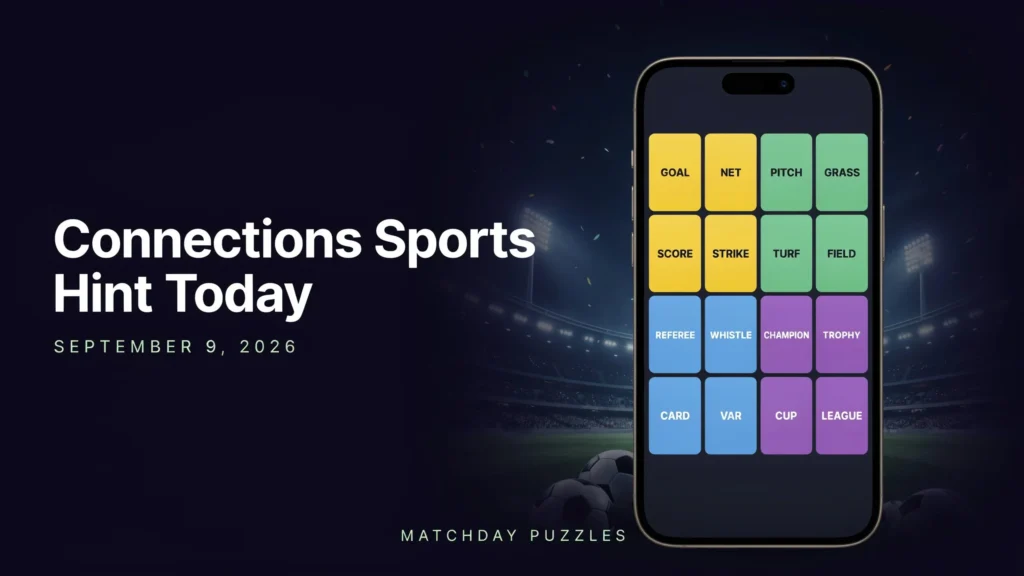
Today’s Connections Sports Edition puzzle is No. 716 for Wednesday, September 9, 2026. The four categories are centered on tailgating supplies, Super Bowl MVPs, Seattle Seahawks stadium names, and anagrams of NFL teams.
Here is the quick overview:
| Color | Category | Difficulty |
|---|---|---|
| 🟨 Yellow | Tailgating Needs | Easiest |
| 🟩 Green | Super Bowl MVPs | Moderate |
| 🟦 Blue | Names of Seahawks Stadiums | Tricky |
| 🟪 Purple | Anagrams of NFL Teams | Hardest |
If you want to solve the puzzle yourself, stop here and use the hints below before revealing the complete answer.
Today’s Connections Sports Hints
The best way to approach a daily Connections puzzle is to start with a broad clue and only reveal more information when necessary.
🟨 Yellow Hint
Think about the items you might bring to a parking-lot tailgate before a big game.
This group is not about a particular team. Instead, look for practical things that fans might use while preparing food, sitting outside, or spending time before kickoff.
🟩 Green Hint
Think of players who have been named Super Bowl Most Valuable Player.
The words in this group are connected to NFL stars rather than general football terminology. If you recognize famous Super Bowl MVP names, this category should become easier.
🟦 Blue Hint
Think about the different names used for the Seattle Seahawks’ home stadium over the years.
This is a history-based category. Some of the words may look unrelated to football until you connect them to Seattle’s stadium naming history.
🟪 Purple Hint
Look for ordinary words that can be rearranged to spell NFL team names.
This is the trickiest category because the connection depends on wordplay rather than a straightforward sports fact. Try rearranging letters instead of looking for a common subject.
Today’s Connections Sports Categories
If the first hints were not enough, here are the four category names for September 9:
- 🟨 TAILGATING NEEDS
- 🟩 SUPER BOWL MVPS
- 🟦 NAMES OF SEAHAWKS STADIUMS
- 🟪 ANAGRAMS OF NFL TEAMS
These categories are confirmed by current guides covering today’s Sports Edition puzzle.
The category titles give you a much stronger direction without immediately revealing every word on the board.
What Is the Answer to Connections Sports Edition Today?
The complete Connections Sports Edition answer for September 9, 2026 is:
🟨 Yellow: TAILGATING NEEDS
- CHAIRS
- COOLER
- GRILL
- TENT
These are all practical items associated with a tailgate. Fans may bring chairs for seating, a cooler for drinks and food, a grill for cooking, and a tent for shade or shelter.
🟩 Green: SUPER BOWL MVPS
- BRADY
- BRANCH
- EDELMAN
- WALKER
Each surname connects to a player who has won Super Bowl MVP honors. This group is a good example of why athlete knowledge can matter more than ordinary word association in the Sports Edition.
🟦 Blue: NAMES OF SEAHAWKS STADIUMS
- CENTURYLINK
- KINGDOME
- LUMEN
- QWEST
These names are connected with the Seattle Seahawks’ home stadium across different periods and naming arrangements. The category is difficult because the words do not all look like conventional sports vocabulary at first glance.
🟪 Purple: ANAGRAMS OF NFL TEAMS
- BANGLES
- SABRE
- TAR PITS
- TREELESS
This is the most wordplay-heavy group. Each entry can be rearranged to form the name of an NFL team.
The purple group is a classic example of a Connections category in which the words themselves can act as distractions. Rather than asking what the words mean, ask what their letters can become.
Today’s Full Connections Sports Answer at a Glance
| Category | Four Answers |
|---|---|
| 🟨 TAILGATING NEEDS | CHAIRS, COOLER, GRILL, TENT |
| 🟩 SUPER BOWL MVPS | BRADY, BRANCH, EDELMAN, WALKER |
| 🟦 NAMES OF SEAHAWKS STADIUMS | CENTURYLINK, KINGDOME, LUMEN, QWEST |
| 🟪 ANAGRAMS OF NFL TEAMS | BANGLES, SABRE, TAR PITS, TREELESS |
Today’s puzzle therefore combines straightforward sports lifestyle vocabulary with NFL history, stadium knowledge, and a more abstract letter-based category.
How to Play Connections Sports Edition
The rules are straightforward.
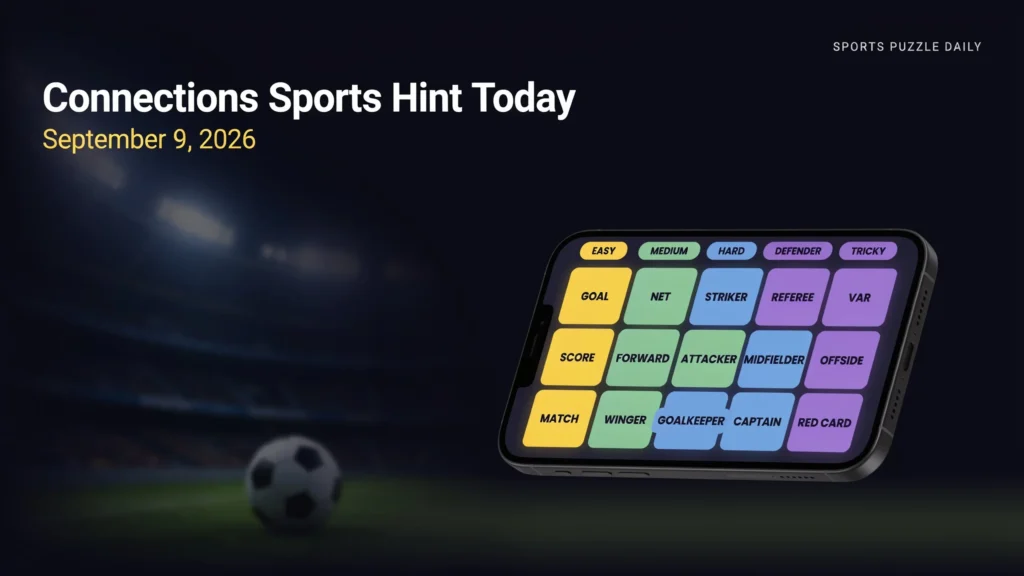
You begin with 16 words or short phrases arranged in a puzzle grid. Your job is to divide those tiles into four groups of four.
Each group has a hidden connection.
To solve the puzzle: nytsolvers.com
- Read all 16 words before making a selection.
- Look for four items that clearly belong together.
- Select those four tiles.
- Submit your guess.
- If the group is correct, it is removed from the board.
- Continue with the remaining words.
- Use the remaining guesses carefully because incorrect selections count against you.
The official New York Times Help Center describes the Sports Edition as following the same rules as the regular Connections game.
What Do the Colors Mean?
The categories use four colors to represent increasing difficulty:
- Yellow: generally the easiest connection
- Green: moderately difficult
- Blue: more challenging
- Purple: usually the most difficult or wordplay-heavy
This color system gives you a useful solving strategy. If you can confidently identify Yellow, solving it first removes four distractions from the puzzle grid.
How to Use a Connections Sports Hint Today
A good hint should help you solve the category without immediately giving away every answer.
Try this progression:
First, identify the broad theme.
Ask whether the words relate to a sport, team, player, stadium, award, event, or piece of equipment.
Next, look for four strong matches.
Do not select words simply because they are vaguely related. Connections categories usually require a precise relationship.
Then, check for a stronger alternative.
If one word appears to fit two categories, that may be intentional. Connections frequently uses overlapping associations to create misleading groups.
Finally, use the full answer only when necessary.
If you are stuck after several attempts, checking the category can help you understand the puzzle rather than simply memorizing the solution.
For today’s puzzle, the most difficult step is likely the Purple category because the connection is based on anagrams rather than a direct sports topic.
Why Sports Connections Can Be Harder Than Regular Connections
Sports knowledge introduces an additional layer to the usual Connections format.
In the standard game, you may recognize a group because four words share a definition, phrase, object, or cultural reference. In the Sports Edition, the relationship may depend on knowledge of a specific league, player, team, stadium, award, or sporting event.
For example, a surname such as BRADY could potentially make you think of football, quarterbacks, or the New England Patriots. But today’s puzzle asks you to recognize it specifically as part of the Super Bowl MVP group.
Similarly, a word such as LUMEN may not immediately look like a sports answer. Its connection becomes apparent only when you know the history of the Seahawks’ stadium naming.
That is why the Sports Edition rewards both pattern recognition and sports knowledge.
Tips and Strategies to Solve Connections Sports Faster
Start With the Yellow Category
Yellow is generally the best place to begin because it is designed to be the most approachable category.
Once you solve one group, the board becomes smaller. Four words disappear, leaving you with 12 tiles and fewer possible combinations.
For today’s puzzle, CHAIRS, COOLER, GRILL, and TENT provide a relatively direct tailgating connection.
Do not feel that you have to solve the categories in color order every time, but Yellow is often a useful starting point.
Watch for Words That Fit More Than One Sport
A common Connections trap is a word that appears to belong in multiple groups.
A player surname might refer to several sports. A team nickname might also be an ordinary word. A stadium name might look like a general noun.
When a word fits two possible categories, do not immediately lock it into the first group that comes to mind.
Instead, ask:
- Which four words create the strongest connection?
- Is there a more specific category?
- Does one word make the group feel forced?
- Can the remaining tiles form a cleaner category?
The strongest group usually has four precise matches rather than four vaguely related words.
Think Beyond the Obvious Sport
Do not assume that every group will contain four items from the same sport.
A category can focus on a particular player award, stadium history, team name, championship, or word pattern.
Today’s puzzle demonstrates this clearly:
- One group concerns tailgating.
- One concerns Super Bowl MVPs.
- One concerns Seahawks stadium names.
- One uses NFL team anagrams.
The broader subject is sports, but the individual connections are very different.
Use Your Mistakes Wisely
Do not use guesses simply to test random combinations.
Before submitting four tiles, try to explain the connection between every one of them.
If three words fit perfectly and the fourth feels questionable, stop and look for another possibility.
This is particularly important late in the puzzle, when you have fewer safe opportunities remaining.
Look for Wordplay in Purple
Purple is often where Connections hides its most unusual relationship.
Instead of asking only:
“What do these words have in common?”
also ask:
“Can these letters be rearranged?”
Other useful questions include:
- Can these words become team names?
- Are they altered versions of player names?
- Do they contain a hidden sports term?
- Do they share a specific abbreviation?
- Could the words be rearranged?
- Are they associated with the same event?
Today’s Purple group is an excellent example of why this approach matters.
Use Sports History
A sports-themed puzzle can reach beyond current players and teams.
Think about:
- Former stadium names
- Previous team names
- Championship winners
- Super Bowl MVPs
- Historical records
- Retired numbers
- Former franchises
- Team relocations
- Famous nicknames
If a category seems impossible from current sports knowledge, historical knowledge may unlock it.
Remove Solved Words From Your Thinking
Once a correct group disappears, resist the temptation to keep mentally connecting those words with the remaining tiles.
Start fresh with the smaller board.
This helps prevent an earlier association from influencing your interpretation of the remaining categories.
What Makes Today’s Puzzle Tricky?
Today’s puzzle has several potential distractions.
The Green group depends on recognizing Super Bowl MVPs rather than simply identifying famous NFL players. The Blue group requires knowledge of Seahawks stadium naming history, while Purple relies on anagram-based wordplay.
That combination means a solver can know plenty about sports and still struggle with the puzzle.
The lesson is simple: do not assume every category is testing the same type of sports knowledge.
One group may test athlete trivia. Another may test team history. Another may test wordplay.
How Connections Sports Edition Differs From NYT Connections
The Sports Edition keeps the fundamental structure of NYT Connections but narrows the subject matter toward sports.
Both versions use a grid of 16 tiles and ask players to discover four groups of four. The major difference is the type of knowledge that can help you solve those groups.
| Feature | Regular Connections | Sports Edition |
|---|---|---|
| Grid | 16 tiles | 16 tiles |
| Groups | 4 groups of 4 | 4 groups of 4 |
| Hidden connections | Yes | Yes |
| Difficulty colors | Yes | Yes |
| Sports knowledge | Sometimes useful | Frequently useful |
| Athlete trivia | Occasional | Common |
| Team history | Occasional | Common |
| Sports terminology | Limited | Central |
The official NYT Help Center confirms that the Sports Edition follows the same rules as the regular Connections game.
How Often Is a New Connections Sports Puzzle Released?
A new daily puzzle is released each day. The standard Connections game is released daily at midnight in the player’s timezone, according to the New York Times Help Center.
That daily format is one reason hint pages are useful. Yesterday’s solution is unlikely to help with today’s exact puzzle, while a current page can provide clues for the specific board you are facing.
For September 9, 2026, the Sports Edition puzzle is No. 716.
Should You Check the Full Answer or Just Use a Hint?
That depends on how you want to play.
If you are trying to maintain a streak or improve your solving skills, start with the smallest hint possible.
A useful order is:
- Broad category hint
- More specific clue
- Category name
- Partial answers
- Complete solution
This approach lets you preserve some of the challenge while still getting help when you need it.
If you simply want to know today’s puzzle answer, there is nothing wrong with checking the full solution. The important thing is to understand the connection afterward so you can recognize a similar pattern in a future puzzle.
Why Bookmark This Connections Sports Hints Page?
The value of a daily puzzle guide is freshness.
Every new puzzle brings a different set of words, categories, players, teams, and hidden themes. A page that is updated for the current date can therefore be much more useful than a general explanation of how Connections works.
This page is designed to provide:
- Today’s Connections Sports hints
- The four category clues
- The complete answer
- A breakdown of each group
- Sports-solving strategies
- Explanations of difficult connections
- Helpful FAQs
- A quick answer table for readers who are in a hurry
If you only need one clue, you can stop after the hint section. If you are completely stuck, continue to the full answer.
Frequently Asked Questions About Connections Sports Edition
What Is Connections Sports Edition?
Connections: Sports Edition is the sports-focused version of the Connections word puzzle. Players sort 16 sports-related words or phrases into four groups of four based on hidden connections. The Sports Edition is brought to solvers by The Athletic and follows the core rules of the regular Connections game.
How Many Categories Are in Connections Sports Edition?
There are four categories in each puzzle. Each category contains four tiles, creating a total of 16 tiles on the board.
How Many Words Are in Connections Sports Edition?
Each puzzle contains 16 words or short phrases. You must organize them into four groups of four.
What Are Today’s Connections Sports Answers?
For September 9, 2026, the four groups are TAILGATING NEEDS, SUPER BOWL MVPS, NAMES OF SEAHAWKS STADIUMS, and ANAGRAMS OF NFL TEAMS. The complete answers are listed earlier in this guide.
What Does the Yellow Category Mean?
Yellow represents the easiest category in the standard difficulty color system. It is generally a good place to begin because its connection is more direct than the other groups.
What Does the Purple Category Mean?
Purple represents the hardest category. It often contains a more obscure connection, wordplay, or a relationship that is difficult to spot immediately.
How Can I Get Better at Sports Connections?
Build your sports knowledge while also practicing general Connections strategies. Learn major team names, player surnames, championships, stadiums, awards, terminology, and sports history. At the same time, practice identifying wordplay and spotting misleading connections.
Where Can I Find Today’s Connections Sports Hints and Answers?
A current daily puzzle guide can provide spoiler-free clues, category names, and the complete answer. The official Sports Edition is available through the New York Times Games ecosystem and The Athletic’s platforms.
Is Connections Sports Edition the Same as the Regular NYT Connections Game?
It uses the same fundamental puzzle structure, but the Sports Edition focuses specifically on sports-related knowledge and themes. The New York Times Help Center describes it as the sports version of Connections brought to solvers by The Athletic.
September 9, 2026 Connections Sports Answer: Quick Recap
If you only came here for the answer, today’s puzzle contains:
🟨 Yellow — TAILGATING NEEDS:
CHAIRS, COOLER, GRILL, TENT
🟩 Green — SUPER BOWL MVPS:
BRADY, BRANCH, EDELMAN, WALKER
🟦 Blue — NAMES OF SEAHAWKS STADIUMS:
CENTURYLINK, KINGDOME, LUMEN, QWEST
🟪 Purple — ANAGRAMS OF NFL TEAMS:
BANGLES, SABRE, TAR PITS, TREELESS
The September 9 puzzle is a good example of how the Sports Edition mixes direct sports trivia with historical knowledge and wordplay.
Final Thoughts
The best way to solve a Connections Sports puzzle is not simply to know more sports facts. You also need to recognize how the puzzle is trying to connect those facts.
Start with the clearest category, remove solved words from consideration, and pay attention when a word seems capable of fitting more than one group. When the remaining board becomes difficult, shift your thinking from sports trivia to wordplay, history, stadiums, awards, or team names.
For September 9, the easiest path is to recognize the tailgating group first, then work through the Super Bowl MVPs and Seahawks stadium names before tackling the NFL anagrams.
And if you get stuck, use a hint before revealing the full answer. Sometimes one well-placed clue is all you need to see the hidden pattern.
Also Read
LSG vs DC
Chicago Sky vs Dallas Wings Match Player Stats
BMW Championship 2025